Choosing a cocktail shaker sounds simple — until you’re staring at a catalog of French shakers, Boston shakers, tin-in-tin designs, cobbler shakers, and glass variants, trying to figure out which one will actually hold up under daily use.
This guide cuts through the noise. Whether you’re a home enthusiast mixing weekend Negronis, a bar manager stocking a new venue, a distributor sourcing private-label products, or a hospitality buyer comparing suppliers, we’ll walk you through every factor that matters: material, seal type, capacity, durability, skill level, price range, and the hidden variables that separate a shaker that lasts five years from one that bends out of shape in six months.
As a cocktail shaker manufacturer since 2007, LARBO has produced millions of shakers for clients in 56+ countries. This guide distills that experience into actionable advice.
In this guide:
- Quick Decision: Which Shaker Is Right for You?
- The 7 Factors to Consider When Choosing a Cocktail Shaker
- 6 Types of Cocktail Shakers Compared
- Material: Stainless Steel vs Glass vs Copper vs Plastic
- Size & Capacity: Matching Shaker to Venue
- Seal Type: Twist vs Friction vs Flip-Top
- Beginner vs Professional: Which Shaker for Your Skill Level?
- Price vs Quality: What You Get at Each Price Point
- Key Specs to Verify Before Ordering
- Top LARBO Shakers for Every Budget
- 15 Questions to Ask Your Supplier
- Frequently Asked Questions
Quick Decision: Which Shaker Is Right for You?
If you want the short answer before diving into the details:
| Your Situation | Best Choice | Why |
|---|---|---|
| Home bartender, first cocktail shaker | Cobbler Shaker | All-in-one design, no technique needed |
| Professional bartender, high-volume bar | Tin-in-Tin Shaker | Fastest, unbreakable, best thermal performance |
| Upscale cocktail lounge | French Shaker | Most elegant pour, premium presentation |
| Outdoor/pool bar | Leather-Wrapped Shaker | Heat protection, non-slip grip |
| Retail/gift set buyer | Cobbler Shaker | Best perceived value, wide size range |
| Batch cocktails / large events | 1800ml Cobbler | 4+ cocktails in one shake |
| Source in bulk / private label | Contact LARBO | All types, full customization |
For a deeper head-to-head comparison of the three main styles, see our Boston Shaker vs Cobbler Shaker vs French Shaker guide.
The 7 Factors to Consider When Choosing a Cocktail Shaker
Before we dive into types and materials, here are the seven factors that should guide your decision:
- Type — Boston, cobbler, French, or specialty? Each has a different workflow and learning curve. Professional bartenders overwhelmingly prefer Boston or tin-in-tin shakers; home bartenders gravitate toward cobbler shakers.
- Material — Stainless steel (304 grade) is the industry standard for durability, chilling speed, and flavor neutrality. Glass is beautiful but breakable. Copper chills fastest but tarnishes and requires hand washing. Plastic is lightweight but scratches easily and can retain odors.
- Size — A 500–700ml shaker handles 1–2 cocktails comfortably, making it the sweet spot for most users. Home bartenders can go smaller (350–500ml); commercial bars need 800ml+ for multi-drink shaking.
- Ease of Use — Cobbler shakers with built-in strainers are the most beginner-friendly. Boston shakers require technique but reward you with speed. French shakers sit in the middle: simpler than Boston but still need a separate strainer.
- Durability — Look for 304 stainless steel with a wall thickness of at least 0.5mm. Thin walls dent easily and warp under repeated use. Tin-on-tin Boston shakers are the most durable design since they’re all metal with no glass parts.
- Seal Quality — A good seal prevents leaks during shaking but should break cleanly when you want to pour. Twist/bayonet seals (French shakers) are the most reliable; friction-fit seals (Boston shakers) are fastest but require technique. Flip-top caps on cheap cobbler shakers are the least reliable.
- Price — Expect to pay 15–30 for a quality home shaker and 25–60 for a professional-grade tool. Below 10,you′relikelygettingthinstainlesssteel,poorfinishing,orunreliableseals.ForB2Bbuyerssourcinginbulk,factory−directEXWpricesrangefrom1.40–$6.50/unit depending on type, size, and finish. See our MOQ and pricing guide.
The 6 Types of Cocktail Shakers
Every shaker on the market falls into one of these six categories:
| Type | Best For | Main Advantage | Main Limitation |
|---|---|---|---|
| Boston Shaker (glass-on-tin) | Professional bars, speed service | Fast, large capacity, visual mixing | Glass can break; requires technique |
| Tin-in-Tin Shaker | High-volume commercial bars | Unbreakable, superior thermal insulation | Heavier; steeper learning curve |
| French (Parisian) Shaker | Premium bars, craft cocktails | Elegant pour, comfortable grip | Smaller capacity; needs separate strainer |
| Cobbler Shaker | Home bartenders, beginners, gift sets | All-in-one, easiest to use | Slower in professional settings |
| Glass Cocktail Shaker | Visual presentation, home use | Aesthetic appeal, no metallic taste | Fragile; not for commercial use |
| Leather-Wrapped Shaker | Outdoor bars, branding, premium gifts | Heat protection, non-slip, premium look | Leather requires care |
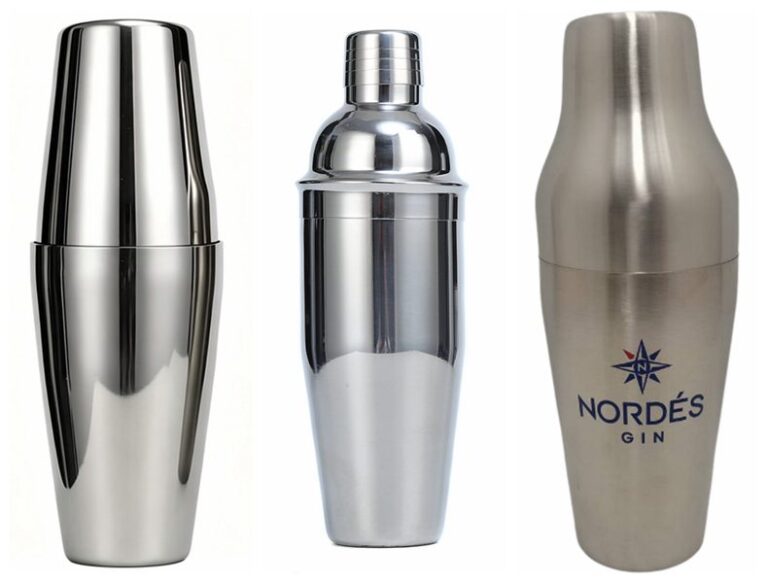
Boston Shaker (Glass-on-Tin)
The industry standard. Two pieces: a metal mixing tin and a slightly smaller glass. Fast to use once trained, with an 800ml capacity ideal for high-volume service. The main skill is tapping the side to break the seal cleanly — bartenders call this the “pop” technique. The glass lets you see the cocktail’s color and dilution progress, which is useful for precision work.
→ Boston Shaker with Mixing Glass
Tin-in-Tin Shaker
Two stainless steel shells, one nested inside the other, creating an air gap that dramatically improves thermal insulation. When you add ice, the inner shell chills faster and stays cold longer than any other design — critical when shaking 200+ drinks per night. Completely unbreakable, making it the choice for bars with concrete floors and outdoor service.
French (Parisian) Shaker
A single tapered metal cylinder with a curved cap that fits over the body. The sleek, elegant profile makes it the most visually distinctive shaker style. The cap’s bayonet-style twist seal creates a leak-proof lock. Used by premium cocktail bars worldwide where presentation matters as much as performance.
Cobbler Shaker
The 3-piece design (body + built-in strainer cap + top lid) is the most recognizable shaker globally. No separate strainer needed, no technique to learn — fill, cap, shake, pour. Available in the widest size range: from 250ml mini shakers for single servings to 1800ml large shakers for batching. Dominates the home bar and gift set markets.
→ 1800ml Large Cobbler | 550ml Standard Cobbler | 350ml Cobbler
Glass Cocktail Shaker
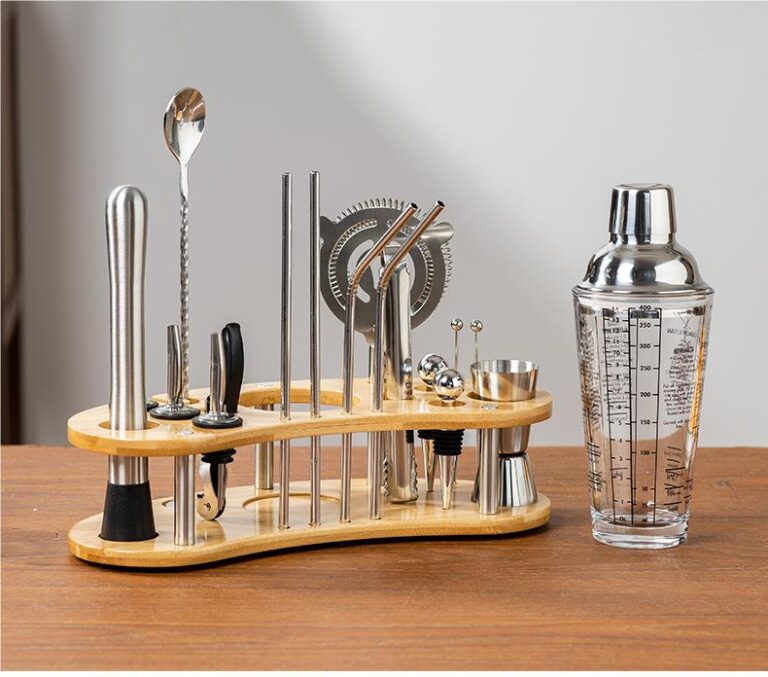
A crystal-clear glass body with a stainless steel cap. The glass construction showcases the cocktail’s color and layers — ideal for demonstration, social media content, and bars where visual presentation is part of the experience. Our glass shakers use lead-free crystal glass with a 304 stainless steel cap in gold, rose gold, or silver finish.
Leather-Wrapped Shaker
A 304 stainless steel cobbler-style body wrapped in high-density PU leather. The leather provides thermal insulation (hands stay comfortable during extended shaking sessions) and a non-slip grip on wet counters. Popular for outdoor bars, rooftop venues, and branded corporate merchandise.
→ Leather-Wrapped Shaker 650ml
Material: Stainless Steel vs Glass vs Copper vs Plastic
The material your shaker is made from directly affects durability, thermal performance, flavor preservation, and maintenance.
| Factor | 304 Stainless Steel | Glass | Copper | Plastic |
|---|---|---|---|---|
| Durability | Virtually unbreakable | Breakable; thermal shock risk | Durable but dents easily | Scratches; can crack |
| Chill Speed | Fast | Slow | Fastest (best conductivity) | Slow |
| Thermal Retention | Good | Poor | Good | Poor |
| Flavor Impact | 100% neutral | 100% neutral | Slight metallic taste | Can absorb odors |
| Weight | 200–500g | 500–800g | 300–600g | 100–200g |
| Dishwasher Safe | Yes | Yes | No (tarnishes) | Top rack only |
| Price Point | $-$$ | $-$$ | $$$ | $ |
| Best For | All uses — professional & home | Home bars, visual cocktails | Craft bars, display | Budget/travel kits |
Why 304 Stainless Steel Is the Industry Standard
- Food-grade composition: 18% chromium + 8-10.5% nickel — resistant to corrosion, rust, and pitting even after thousands of dishwasher cycles
- Non-reactive: Won’t interact with citrus, spirits, or high-ABV ingredients — 100% flavor-neutral
- Fast chilling: High thermal conductivity transfers cold from ice to liquid faster than glass
- Low maintenance: Dishwasher-safe, no special cleaning products, no seasoning required
- Long service life: A quality 304 SS shaker lasts 5–10+ years in professional use
Warning on 201 vs 304 grade: Budget shakers often use 201-grade stainless steel (lower nickel content). 201-grade shakers can rust, develop metallic odors, and pit after repeated dishwasher use. Always verify material certification. All LARBO shakers use certified 304-grade steel with mill test certificates provided.
→ For a deeper material breakdown, see our What Should a Cocktail Shaker Be Made Of? article.
Size & Capacity: Matching Shaker to Venue
Choosing the right size means balancing drink volume against physical comfort:
| Capacity | Best For | Typical Use Case | Limitation |
|---|---|---|---|
| 250–350ml | Mini shakers, single serve, samples | Flight tastings, gift set items, compact bars | Very limited capacity |
| 350–500ml | Home bartenders, one drink at a time | Single Negroni, Daiquiri, Margarita | Not enough ice space for 2 drinks |
| 500–700ml | Most bars, 1–2 drink batches | Industry sweet spot — fits ice + 2 cocktails comfortably | None |
| 700–800ml | Professional bars, batch cocktails | 2-3 cocktails at once, Boston shaker standard | Heavier; more ice needed |
| 800ml+ | High-volume bars, events | 3-4 cocktails in one shake, tin-in-tin | Heavy to handle; may fatigue during long shifts |
| 1800ml | Large events, catering | 5-6 cocktails, large cobbler | Very heavy when full; two-handed operation |
General sizing rules:
- Home bartenders → 350–550ml is comfortable and easy to store
- Professional bars (moderate volume) → 650–750ml is the optimal range
- High-volume nightclubs and events → 800ml+ for speed batching
- Bartending schools and training kits → Consider the 17-Piece Bartending Kit, which includes a shaker plus all complementary tools
A shaker should feel balanced when half-full. If it feels unwieldy when full, it will feel uncomfortable after 20+ shakes per shift.
Seal Type: Which Mechanism Performs Best?
The seal is where most shaker failures happen. There are three main types:
Twist Seal (Bayonet) — Most Reliable
Used by French shakers. Insert the cap, twist 90°, and bayonet tabs lock into position. Creates a leak-proof mechanical seal that withstands vigorous shaking. The built-in strainer makes this the fastest system for single-drink service.
Best for: Professional bars prioritizing reliability and presentation.
Friction Fit (Boston Style) — Fastest When Mastered
The two-piece design relies on a tight friction fit between the shaker tin and the glass/metal bottom. The vacuum created by cold ingredients + room-temperature metal locks the seal. Works extremely well but requires technique — the seal can stick if there’s moisture or oil on the rim.
Best for: High-volume bars where speed matters more than foolproof operation.
Flip-Top / Pull-Off Lid — Least Reliable
Found on budget cobbler shakers. A small cap that sits on top of the built-in strainer. Easy to operate one-handed but can work loose during vigorous shaking. Not recommended for commercial use.
Best for: Home use, casual cocktail making.
Beginner vs Professional: Which Shaker for Your Skill Level?
Your experience level should heavily influence your choice:
Beginners: Start with a Cobbler Shaker
If you’re new to cocktail making, the cobbler shaker is your best friend. The all-in-one design eliminates the two most common beginner struggles: forgetting to strain and not knowing how much ice to add. With a cobbler shaker, you fill the body, snap on the strainer cap, add the small top lid, shake, remove the lid, and pour — all in one tool.
Recommended for beginners: 550ml Standard Cobbler — the perfect size, weight, and price point for learning.
Intermediate: Graduate to a French or Boston Shaker
Once you’ve made 50+ cocktails and understand the basics of shaking technique, you’ll appreciate the speed and control of a Boston or French shaker. The transition isn’t difficult — it takes about a week of daily use to develop reliable muscle memory for the Boston seal.
Recommended for intermediate: French Shaker 660ml or Boston Shaker Set.
Professional: Go Tin-in-Tin
Professional bartenders who shake 100+ drinks per shift need speed, durability, and thermal performance. The tin-in-tin shaker delivers on all three: it’s unbreakable, chills faster than any other design, and seals/opens in under a second with practice.
Recommended for professionals: Tin-in-Tin Shaker 800ml.
Price vs Quality: What You Get at Each Price Point
Understanding what you’re paying for at each tier helps avoid overpaying — or worse, buying something that fails after a month:
| Price Tier | Price Per Unit (Retail) | What to Expect | Risk |
|---|---|---|---|
| Budget ($5-10) | $5-10 | Thin steel (often 201 grade), rough seams, loose-fitting caps, inconsistent pouring | Rust within months; leaks after repeated use; poor seal |
| Mid-Range ($15-30) | $15-30 | 304 SS, smooth finish, decent seal, weight-balanced | Quality varies by brand; check reviews |
| Premium ($30-60) | $30-60 | Heavy-gauge 304 SS, mirror polish, weighted base, consistent seal | Typically excellent quality |
| B2B Factory Direct | $1.40-6.50 EXW | Custom specs, certified 304 SS, full QC, branding options | Longer lead time; MOQ applies |
For B2B buyers: Factory-direct pricing eliminates 3-4 layers of markup. A 25retailcobblershakeroftencosts2-3 to manufacture. See our full pricing guide for EXW ranges by shaker type and quantity.
Key Specs to Verify Before Ordering
Before placing a shaker order — whether stock or OEM — confirm these specifications with your supplier:
Material Certification
- 304 stainless steel confirmed (request mill certificate)
- FDA / LFGB / EU food contact compliance documentation
- Lead-free certification (for glass components)
- Nickel content between 8.0–10.5% (spectrometer verification)
Dimensional Consistency
- Capacity tolerance within ±5% of stated volume
- Wall thickness ≥ 0.5mm for home use, ≥ 0.8mm for commercial
- Rim finish: rolled (smooth) not cut (sharp)
- Dimension specs confirmed before production
Quality Verification
- Pressure/leak test protocol for seal integrity
- Drop test procedure (standard for commercial bar equipment)
- Sample approval process before mass production
- Third-party inspection availability (SGS, Bureau Veritas, TÜV)
MOQ and Lead Time
- Stock MOQ: 50–500 pieces (varies by product)
- OEM/ODM MOQ: 500–1,000 pieces
- Sample lead time: 2–10 days
- Production lead time: 20–40 days
Top LARBO Shakers for Every Budget
| Shaker Type | Capacity | Material | Best For |
|---|---|---|---|
| Tin-in-Tin | 800ml/650ml | 304 SS | High-volume commercial bars |
| French Shaker | 660ml/580ml | 304 SS | Professional cocktail bars |
| Insulated Cobbler | 500ml | 304 SS (double-wall) | Outdoor bars, poolside service |
| Leather-Wrapped Shaker | 650ml | 304 SS + PU leather | Premium branding, gift sets |
| 1800ml Large Cobbler | 1800ml | 304 SS | Batching, large events |
| Standard Cobbler | 550ml | 304 SS | Home bartenders, beginners |
| Glass Cocktail Shaker | 385ml/13oz | Crystal glass + 304 SS cap | Visual cocktails, gift sets |
| 17-Piece Bartending Kit | Full kit | 304 SS + wood stand | Training, starter inventory |
15 Questions to Ask Your Supplier Before Ordering
Before signing with any barware supplier, get clear answers on:
- What material certification do you provide? (Mill cert, FDA, LFGB?)
- Can I get a pre-shipment sample?
- What’s your MOQ for stock vs. custom logo products?
- What is your lead time from order to shipment?
- Do you offer pressure testing or quality inspection reports?
- What’s your defect rate on previous orders?
- Can you produce to EU/US packaging and labeling standards?
- What payment terms do you offer?
- Do you provide OEM/ODM services?
- Can you accommodate urgent or rush orders?
- What are your packaging options? (retail box, bulk, etc.)
- Do you have a minimum reorder policy?
- Can you provide references from other barware buyers?
- What is your quality dispute resolution process?
- Do you ship to my country and what are the options?
Frequently Asked Questions
What is the best cocktail shaker for a busy bar?
For high-volume commercial bars, the tin-in-tin or Boston shaker is the industry standard. The tin-in-tin design offers superior thermal insulation, keeping ice cold longer during back-to-back service. The LARBO Tin-in-Tin Shaker (304 stainless steel, 800ml) is built specifically for commercial bar environments.
What is the difference between a French shaker and a Boston shaker?
A French shaker has a single tapered metal body with a cap that fits over the body (bayonet seal), creating a 2-piece system. A Boston shaker uses a metal tin paired with a glass or smaller tin (2-piece). French shakers pour more elegantly; Boston shakers are faster for high-volume work. See our detailed comparison: Boston vs Cobbler vs French.
How do I stop my shaker from sticking?
Sticking occurs when moisture or oil breaks the friction seal. Fixes: (1) Ensure the shaker tin is completely dry before assembly; (2) Tap the seal at an angle, not directly in line with the tin; (3) Practice the proper shake angle. The French Shaker’s bayonet seal eliminates this problem entirely.
What size cocktail shaker should I order?
For single-drink service: 350–550ml. For most commercial bars: 650–750ml. For high-volume batch service: 800ml+. The LARBO product range covers 250ml to 1800ml so every venue size is accommodated. See the full size guide above.
Can I get cocktail shakers with my own logo?
Yes. LARBO offers OEM/ODM services including laser engraving, silk screen printing, embossing, and PVD color coating on 304 stainless steel shakers. Custom packaging is available for orders over 5,000 pcs. Contact us for a custom branding quotation.
What MOQ should I expect for custom cocktail shaker orders?
Stock product MOQs start at 50–500 pieces depending on the product. Custom OEM/ODM orders (custom logo, custom packaging, custom dimensions) generally start at 500–1,000 pieces. See our MOQ & pricing page for full details.
Are glass cocktail shakers worth buying?
Glass shakers are a good choice for home bartenders who value visual presentation and don’t mind the breakage risk. For commercial bars, glass shakers are not recommended — they can shatter during busy service, creating safety hazards and inventory loss. If you want the glass look without the risk, consider a 304 stainless steel shaker with a mirror finish — equally attractive and virtually indestructible.
How long should a quality cocktail shaker last?
A well-made 304 stainless steel shaker should last 5–10+ years in home use and 2–5 years in daily professional use. Signs it’s time to replace: rust spots, dents that affect the seal, thinning walls, or a cap that no longer fits snugly. If your shaker shows any of these within the first year, the material quality is likely substandard.