
If you have ever stood in front of a wall of bar tools and wondered whether to grab the tall, elegant jigger or the short, familiar one, you are not alone. The Japanese jigger vs standard jigger debate is one of the most common questions among home bartenders and professionals alike. Both measure liquor — but they do it in very different ways, and choosing the right one can change the consistency, speed, and even the aesthetic of your cocktail program. In this guide, we break down every difference so you can pick with confidence.
What Is a Japanese Jigger?
The Japanese jigger is the precision instrument of the bar world. Inspired by the meticulous culture of Japanese bartending — where a single milliliter can make or break a drink — this tool is designed for control above all else.
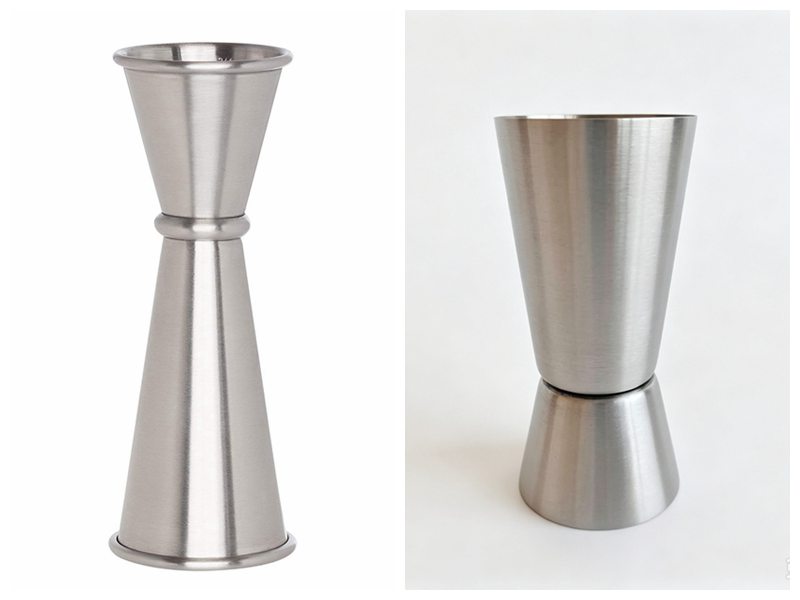
It is instantly recognizable by its tall, slim hourglass profile, roughly twice the height of a standard bell jigger. The elongated body creates a narrower opening, which slows the pour and gives the bartender more time to stop at the exact target volume. Each cone is etched with internal measurement markings, so you can read fractional pours (e.g., 15 ml, 30 ml, 45 ml) from the inside without needing a separate measuring line on the outside.
The base is proportionally heavier than the cone, lowering the center of gravity so a full jigger sits securely on the bar without tipping. Quality Japanese jiggers — like the stainless steel Japanese jigger we manufacture at LARBO — are seamless one-piece constructions, deep-drawn from a single sheet of 304 stainless steel with no welds or seams. The rim is rolled, not cut, creating a smooth, drip-free pouring edge.

What Is a Standard Jigger?
The standard jigger — often called a bell jigger or double jigger — is the workhorse you will find in most home bars and high-volume establishments. It consists of two opposing cones joined at the middle, forming a compact hourglass that fits easily in one hand.
Typical capacities are 1 oz / 2 oz (25 ml / 50 ml in metric markets), and the two cones give you two fixed measurements with no intermediate markings. Some models have measurement lines stamped on the outside, but many do not — you simply fill the cone to the brim.
Because it is shorter and wider, the standard jigger is faster to pour and easier to handle, especially during a busy Friday-night rush. The trade-off is accuracy: without internal markings, you are estimating fractional pours, and the wider opening means liquid moves faster, making it harder to stop precisely at a target volume.

Japanese Jigger vs Standard Jigger: Key Differences
Here is a side-by-side comparison of the most important factors:
| Feature | Japanese Jigger | Standard (Bell) Jigger |
|---|---|---|
| Shape | Tall, slim hourglass (~2× taller) | Short, compact double-cone |
| Measurement markings | Internal etched lines (multiple per cone) | External stamp or none (fill to brim) |
| Pouring accuracy | ±1 ml | ±3–5 ml (estimated) |
| Pour speed | Slower (narrow opening = more control) | Faster (wide opening = quick fill) |
| Base stability | Weighted, sits flat without tipping | Lighter, can wobble if set down full |
| Construction | Seamless one-piece (deep-drawn 304 SS) | Often two-piece welded at the waist |
| Lip edge | Rolled, drip-free | Cut or simple edge |
| Best for | Precision cocktails, craft bars, home enthusiasts | High-volume service, casual home use |
| Price range | Higher ($8–$25 retail) | Lower ($3–$12 retail) |
| Learning curve | Moderate (read internal lines) | Easy (fill to brim) |
The defining feature of a Japanese jigger. Each cone is etched with capacity lines, so one cone can measure 15 ml, 30 ml, or 45 ml — no second tool needed.
The heavier base lowers the center of gravity. A full jigger sits securely on the bar without tipping — a small detail that matters when your hands are busy.
Precision deep-drawn from a single sheet of 304 stainless steel. No welds, no seams, no weak points — and no crevices for residue to build up.
The rim is rolled, not cut. This creates a smooth, drip-free pouring edge that will not cut fingers during rapid handling and reduces wasted liquor.
Which Jigger Is Right for You?
There is no universally “better” jigger — only the one that fits your context. Here is how to decide:
If you make cocktails a few times a week and want consistent drinks without overthinking, a standard bell jigger is perfectly adequate. It is affordable, intuitive, and fast.
Pick: Standard jigger — unless you enjoy the craft and want to level up.
If you run a cocktail program where balance matters — Negronis, Daiquiris, Martinis — the Japanese jigger’s ±1 ml accuracy ensures every guest gets the same drink tonight as last week.
Pick: Japanese jigger — precision is non-negotiable.
If speed is the priority — hundreds of simple highballs and rum-and-cokes per shift — the standard jigger’s wide opening and brim-fill method keep things moving. Precision takes a back seat to throughput.
Pick: Standard jigger — speed wins.
Many professionals keep both on hand: a Japanese jigger for craft cocktails and a standard jigger for high-volume service. If you are building a complete bar tool set, having one of each gives you maximum flexibility.
Why Precision Matters in Cocktail Making
Cocktail consistency depends on measurement accuracy. A 5 ml variance in a Negroni changes the entire drink balance — and a customer who loved their cocktail last visit will notice when it tastes different this time.
This is why Japanese bartending culture treats the jigger as an extension of the hand. The tall profile forces a slower, more deliberate pour. The internal lines let you hit 15 ml, 22 ml, or 30 ml without switching tools. And the ±1 ml manufacturing tolerance — verified with graduated reference cylinders before shipment — means the measurement you see is the measurement you get.
For bars that batch cocktails or pre-bottle service, this consistency is even more critical. A batch recipe scaled up from a single drink amplifies any measurement error. Starting with a precision jigger ensures the foundation is correct before you scale.
How to Choose a Quality Japanese Jigger
If you have decided a Japanese jigger is right for you, here is what to look for:
- Material: 304 stainless steel is the standard. It is corrosion-resistant, dishwasher-safe, and will not react with citrus or alcohol. Avoid plated or coated jiggers — the coating wears off.
- Capacity: Common sizes are 15/30 ml, 20/40 ml, and 25/45 ml. Choose based on your most-used recipes. A 15/30 ml jigger covers most classic cocktails.
- Internal markings: Look for etched (not printed) lines. Printed markings fade with washing; etched lines last the lifetime of the tool.
- Seamless construction: Check for a weld line at the waist. A true one-piece deep-drawn jigger has no seam — stronger, easier to clean, and more hygienic.
- Weight balance: Hold it (or check the spec). The base should feel noticeably heavier than the cone. This prevents tipping when set down full.
Our stainless steel Japanese jigger checks every box: 304 SS, seamless deep-drawn construction, etched internal lines, weighted base, rolled lip, and ±1 ml calibrated accuracy. It is the same tool we supply to bars and distributors in 56+ countries.

Pro Tips: Getting the Most Out of Your Jigger
- Read at eye level. Liquid curves at the edges (the meniscus). Always check the measurement line at eye level, looking at the bottom of the curve.
- Use the pour-and-cut technique. Pour steadily, then cut the pour with a quick wrist flick. The narrow opening of a Japanese jigger makes this motion clean and repeatable.
- Keep it dry between pours. A wet jigger exterior causes the next pour to cling and drip. Wipe between uses during service.
- Pair with a good bar spoon. For layered drinks, a Japanese jigger plus a quality bar spoon gives you the control needed for precise layering and stirring.
Frequently Asked Questions
Is a Japanese jigger more accurate than a standard jigger?
Yes. Japanese jiggers are calibrated to ±1 ml accuracy at full capacity, thanks to internal etched measurement lines and a narrow opening that slows the pour. Standard bell jiggers rely on filling to the brim, which typically yields ±3–5 ml of variance. For craft cocktails where balance is critical, that difference matters.
What sizes do Japanese jiggers come in?
The most common capacities are 15/30 ml, 20/40 ml, and 25/45 ml. The 15/30 ml size covers most classic cocktail recipes. Each cone also has internal sub-markings, so a single 30 ml cone can measure 15 ml, 22 ml, or 30 ml without switching tools.
Can I use a Japanese jigger for high-volume service?
You can, but it is not ideal. The narrow opening and slower pour that make it precise also make it slower than a standard bell jigger. In a high-volume nightclub or sports bar where speed is the priority, a standard jigger’s wide opening and brim-fill method will keep service moving faster.
Are stainless steel jiggers better than plastic?
For professional use, yes. 304 stainless steel is corrosion-resistant, dishwasher-safe, and will not absorb flavors or odors. It also has a satisfying weight and balance that plastic cannot match. Plastic jiggers are cheaper and fine for casual home use, but they scratch easily and do not last as long.
What is the difference between a jigger and a shot glass?
A shot glass is a drinking vessel that happens to hold a standard volume (usually 30 ml or 1 oz). A jigger is a dedicated measuring tool with two cones for different volumes. While you can use a shot glass to measure in a pinch, a jigger — especially a Japanese jigger with internal markings — is far more accurate and versatile for cocktail making.
Need Quality Jiggers for Your Bar or Brand?
LARBO manufactures precision stainless steel jiggers, bar spoons, and complete custom barware for bars, hotels, and distributors worldwide.
MOQ from 500 pcs · Free samples · 15-day sampling · Custom logo & packaging
Or email us at sales@cnlarbo.com · See our FAQ for common questions


