
LARBO customises barware through six logo methods, seven surface finishes and six retail packaging structures. Most programmes start from 500 pieces per design, samples are produced in approximately 15 days, and sampling is free for qualified wholesale enquiries.
Which logo methods are available?
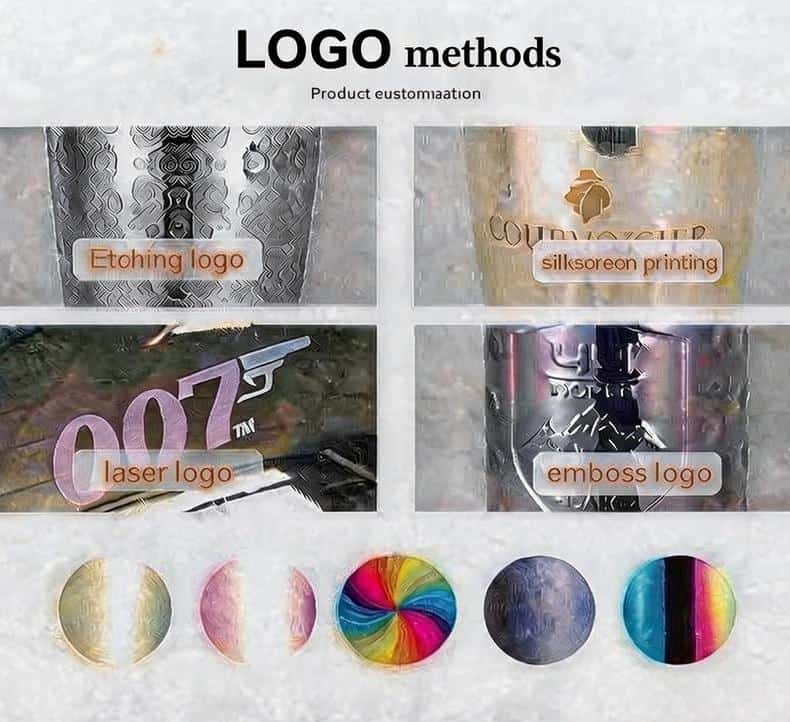
The right method depends on the substrate, the surface geometry and how the item will be washed. A flat shaker body accepts screen printing; a curved mug handle does not. We recommend a method after seeing your artwork and the specific product.
| Method | Best on | Durability | Colour |
|---|---|---|---|
| Laser engraving | Stainless steel, wood, bamboo | Permanent — highest | Single tone (etched) |
| Silk screen printing | Flat or gently curved surfaces | Good — hand wash advised | 1-2 colours (Pantone) |
| Pad printing | Curved, recessed, irregular shapes | Good | 1–3 spot colours |
| 3D printing | Irregular bottles and hard-to-jig shapes | Good — no tooling needed | Full colour |
| Chemical etching | Metal, glass | Permanent | Single tone |
| Embossing / debossing | Leather wraps, gift boxes, hip flasks | Permanent | Optional foil fill |
What surface finishes can you specify?
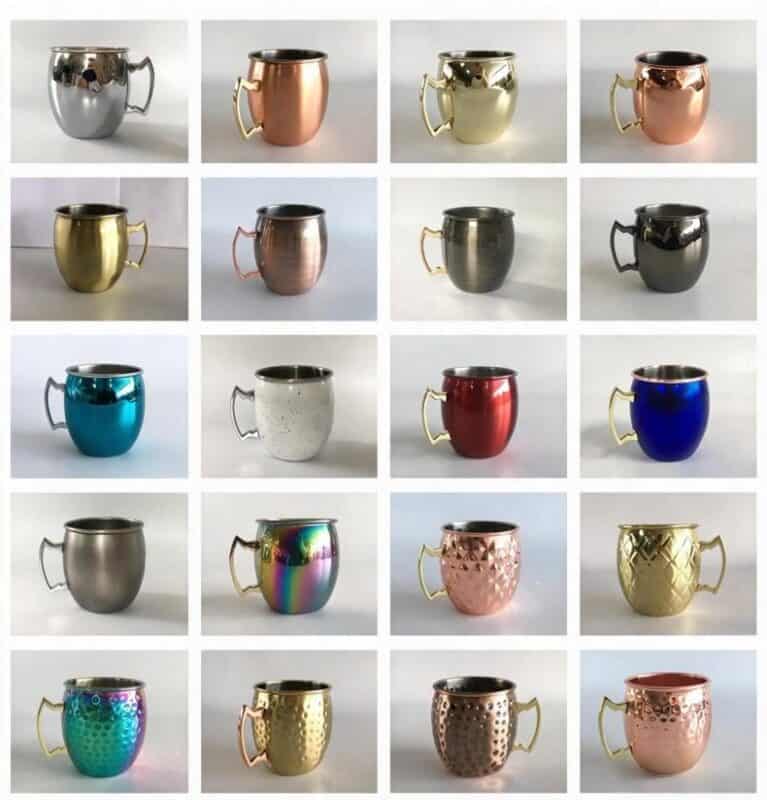
Finish drives perceived value more than any other variable. The same 304 stainless shaker reads as a budget item with a matte finish and as a premium item under PVD rose gold.
| Finish | Appearance | Common use |
|---|---|---|
| PVD coating | Gold, rose gold, black, gunmetal | Premium sets, gift programmes |
| Mirror polish | High-gloss reflective | Classic shakers, jiggers |
| Brushed / satin | Soft directional grain | Hospitality, hides fingerprints |
| Hammered | Dimpled, hand-worked look | Moscow mule mugs, ice buckets |
| Matte / powder coat | Flat colour, soft touch | Black hip flasks, modern sets |
| Copper plating | Warm copper over steel | Cost-effective mule mugs |
| Antique / vintage wash | Aged patina | Heritage brands, bar display |
How does a custom branding programme run?
Seven steps sit between your first enquiry and a shipped order. Knowing the sequence helps you plan backwards from a launch date — the two stages that most often compress a schedule are artwork approval and sample sign-off, and both sit on your side of the timeline.
| Stage | What happens | Typical duration | What you receive |
|---|---|---|---|
| 1. Enquiry and artwork review | We check your logo against the chosen product and recommend a decoration method | 1–2 days | Method recommendation and feasibility notes |
| 2. Quotation | Unit price, tooling if required, and packaging options priced out | 2–3 days | Written quotation |
| 3. Digital proof | Artwork placed on a product template at correct scale | 2–3 days | Digital proof for approval |
| 4. Sampling | Tooling preparation where needed, sample produced and photographed | About 15 days | Physical sample and photo set |
| 5. Sample approval | Adjustments to placement, colour or finish | 3–5 days per revision round | Revised sample if needed |
| 6. Mass production | Production runs through the four checkpoints described on our quality page | 25–35 days typical | Production schedule |
| 7. Pre-shipment inspection | AQL 2.5 sampling, packing check and photo set | 2–3 days | Inspection report and packing photos |
Where a programme runs ahead of or behind schedule, the cause is almost always one of three things: artwork that arrives late, a sample revision round that adds a second tooling pass, or packaging print that is booked after production has started. Sending vector artwork at enquiry stage and approving packaging artwork before mass production begins are the two easiest ways to protect a launch date.
What packaging structures are available?
Packaging is where a private-label programme either looks retail-ready or looks like a bulk shipment. Every structure below can carry your artwork, barcode and compliance marking.
| Structure | Typical MOQ | Best for |
|---|---|---|
| White / brown box | 500 pcs | Bulk distribution, lowest cost |
| Colour printed box | 1,000 pcs | Retail shelf, brand storytelling |
| Rigid gift box | 1,000 pcs | Premium sets, seasonal gifting |
| Window / display box | 1,000 pcs | Product visibility without opening |
| Hang tag / header card | 1,000 pcs | Peg-hook retail, single tools |
| FSC / recyclable pack | 1,000 pcs | ESG-mandated retail programmes |

Structural choice is usually driven by the retail channel rather than by the product. Peg-hook retail needs a header card or hang tag; shelf presentation in a gift category needs a rigid box; e-commerce needs a plain shipper that survives transit. Tell us where the product will be sold and we will recommend the structure first, then the print.
What does branding add to unit cost?
Decoration is usually a small share of unit cost compared with the base product, the finish and the packaging. The two variables that move the number most are how many colours your artwork uses and whether the programme needs new tooling.
| Decoration method | Effect on unit cost | What drives it |
|---|---|---|
| Laser engraving | Lowest | No tooling and no colour; fastest to set up |
| Silk screen printing | Low to moderate | One screen per colour; set-up is amortised over volume |
| Pad printing | Moderate | Pad and plate prepared per artwork |
| 3D printing | Moderate | No tooling; best for full colour on awkward shapes |
| Chemical etching | Moderate | Permanent single-tone mark on metal or glass |
| Embossing / debossing | Higher | Usually applies to packaging and leather wraps |
| New tooling (mould, jig, die) | One-off charge | Quoted per project; existing products with a new logo usually need none |
We quote the base product, the decoration and the packaging as separate lines so you can see what each choice costs before you commit. Sampling is free for qualified wholesale enquiries.
In practice the largest cost surprises come from packaging rather than decoration — a rigid gift box can cost more per unit than the engraving on the product inside it. If you are working to a landed cost target, tell us the number at quotation stage and we will build the specification to it instead of quoting a specification and discovering the gap later.
How long does customisation take?
Sampling runs approximately 15 days from artwork approval, covering tooling preparation, a finished sample and photography. Mass production lead time follows sample sign-off and varies with order size, finish complexity and packaging. New tooling, where required, is quoted per project before anything is committed.
Two things reliably add time, and both are worth planning around. Chinese New Year closes the Yongkang supply chain for two to three weeks, and any order scheduled across that window should be booked well ahead. Peak season from September to November also stretches finishing capacity, particularly for PVD coating and hand-worked hammered finishes. If your launch date is fixed, tell us at enquiry stage and we will build the schedule backwards from it.
For planning purposes, a first programme from enquiry to delivered goods typically runs 60 to 75 days: roughly 5 to 8 days for quotation and proofing, 15 days for sampling, 3 to 5 days per revision round, 25 to 35 days for mass production and 2 to 3 days for inspection, with freight on top. Repeat orders drop the sampling and proofing stages entirely and usually run 30 to 40 days.
What is the minimum order for customised barware?
MOQ starts at 500 pieces for most product types and rises to 1,000 pieces where custom packaging, PVD coating or new tooling is involved. Mixed-SKU orders can often be combined to reach the threshold — worth asking before you drop a design.
The threshold exists because set-up costs are fixed. A screen, a pad or a tooling jig costs the same whether it decorates 50 units or 5,000, so below a certain quantity the per-unit share becomes disproportionate. Where a design genuinely cannot reach the threshold, the usual routes are to combine SKUs into one shipment, accept a higher unit price on a trial quantity, or move to a decoration method with no set-up cost at all — laser engraving is the most common substitute.
Packaging MOQs are set separately from product MOQs because they are printed by a separate supplier. A 500-piece product order with a 1,000-piece colour box is a common mismatch — the usual resolution is to print the boxes once and draw them down over two production runs, which we can hold in stock for you.
Frequently Asked Questions
Can I put my logo on any product?
Almost all of them. The method changes with the item — laser engraving on stainless steel and wood, pad or 3D printing on curved and irregular shapes, screen printing on flat bodies. We confirm the method after reviewing your artwork.
What file format do you need for artwork?
Vector files are preferred — AI, EPS or SVG. For multi-colour printing, supply Pantone references. We return a digital proof for approval before any tooling or sampling begins.
Do I have to pay for tooling?
Only when the design needs a new mould, jig or die. Existing products with a new logo usually need no tooling at all. Where tooling is required, the cost is quoted up front and confirmed in writing before sampling.
Can you match our existing brand colour?
Yes, for printed and powder-coated surfaces we match to a Pantone reference. PVD and plating finishes have a fixed colour range, so we will send physical swatches rather than rely on screen colour.
Can you design the packaging for us?
We provide structural dielines and can produce print-ready artwork from your brand guidelines. Retail compliance elements such as barcodes, country-of-origin marking and recycling symbols are placed to your market’s requirements.
Can I order less than the MOQ?
For a first collaboration we can sometimes accept a trial quantity below standard MOQ, usually at a higher unit price. Combining several SKUs into one shipment is the more common way to reach the threshold.
Ready to brand your barware line?
Send your artwork and target quantity — we will return a logo method recommendation, sampling plan and packaging options.